

Introduction
Preparing for the CBSE Class 10 Science Board Exam can feel overwhelming, but with the right approach and consistent revision, mastering the subject becomes far more achievable. Science is not just about memorising definitions; it is about understanding concepts, exploring applications, and developing clear scientific reasoning.
That’s why Yashwant Classes provides a set of chapter-wise important questions for CBSE Class 10 Science, thoughtfully curated as per the latest syllabus. These questions help strengthen core concepts, improve analytical thinking, and support effective, focused revision—ensuring students are well-prepared for every type of question asked in the final exam.
Begin your preparation with these carefully selected questions and take a confident step towards mastering Science, a subject that builds curiosity, sharpens understanding, and lays the foundation for success in every future academic pursuit.
10th CBSE Board Exam Timetable
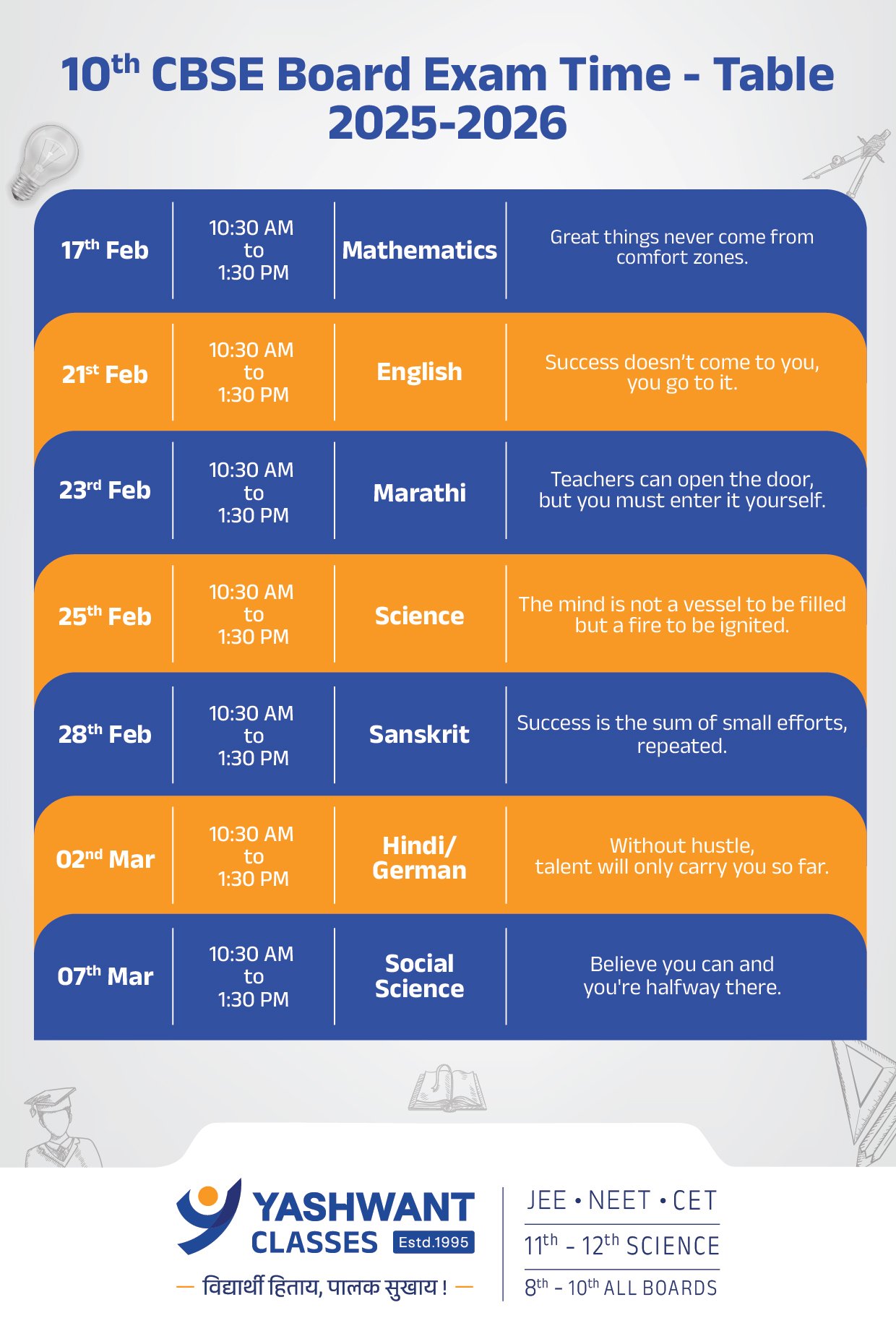
Paper Pattern
Success in the Class 10 board exams depends on a clear strategy and consistent preparation. Students must have a thorough understanding of the syllabus, paper pattern, and chapter-wise weightage to plan their studies effectively. Knowing which topics carry more marks allows for better time management and targeted revision. This guide offers detailed insights into the exam structure, helping students focus on key concepts and maximize their overall performance.
| Section | Question Number | Question type | Marks per Question | Total Questions | Internal Choice |
|---|---|---|---|---|---|
| A | 1-18 | Multiple Choice Questions (MCQs) | 1 mark each | 18 | None |
| - | 19-20 | Assertion-Reason Questions | 1 mark each | 2 | None |
| B | 21-25 | Very Short Answer (VSA) Questions | 2 mark each | 5 | 2 question |
| C | 26-31 | Short Answer (SA) Questions | 3 mark each | 6 | 2 question |
| D | 32-35 | Long Answer (LA) Questions | 5 mark each | 4 | 2 question |
| E | 36-38 | Case Study-Based Questions | 4 mark each | 3 | All queation |
Weightage
In the CBSE Class 10 Mathematics syllabus, Algebra (Unit-II) has the highest weightage at 25% of the total score. Following this, Geometry (Unit-IV) holds approx. 19% weightage. Trigonometry (Unit-V) contributes 15%, and Statistics & Probability (Unit-VII) add approximately. 14%. Mensuration (Unit-VI) accounts for 12.5%, while Coordinate Geometry (Unit-III) and Number Systems (Unit-I) have the lowest weightage, each contributing 7.5%.
| Chapter Name | Marks |
|---|---|
| Chemical Reactions and Equations | 09 |
| Acids, Bases, and Salts | 05 |
| Metals and Non-Metals | 07 |
| Carbon and its Compounds | 05 |
| Periodic Classification of Elements | 01 |
| Life Processes | 08 |
| Control and Coordination | 03 |
| How Do Organisms Reproduce | 05 |
| Heredity and Evolution | 07 |
| Light – Reflection and Refraction | 10 |
| The Human Eye and the Colorful World | 02 |
| Electricity | 07 |
| Magnetic Effects of Electric Current | 05 |
| Sources of Energy | 01 |
| Our Environment | 04 |
| Sustainable Management of Natural Resources | 01 |
Weightage
In the CBSE Class 10 Science syllabus, 'Chemical Substances - Nature and Behaviour' (Unit-I) and 'World of Living' (Unit-II) each have the highest weightage of 31.25%. ‘Natural Phenomena' (Unit-III) contributes 15%, 'Effects of Current' (Unit-IV) holds approximately. 16.5%, and 'Natural Resources' (Unit-V) has the lowest weightage at approx. 6%.
| Units | Units Name | Marks |
|---|---|---|
| I | Number Systems | 06 |
| II | Algebra | 20 |
| III | Coordinate Geometry | 06 |
| IV | Geometry | 15 |
| V | Trigonometry | 12 |
| VI | Mensuration | 10 |
| VII | Statistics and Probability | 11 |
| Total | 80 |
Highlights
- All 39 questions are mandatory, with internal choices provided in selected questions.
- Each section assesses knowledge, comprehension, application, and analytical skills related to scientific concepts.
- The paper includes a variety of question types such as MCQs, Assertion–Reasoning, diagram-based, numerical, and case-based questions.Unit-Wise Weightage for CBSE Class 10 Science
2025-26
| Units | Title | Marks |
|---|---|---|
| I | Chemical Substances – Nature & Behaviour | 25 |
| II | World of Living | 25 |
| III | Natural Phenomena | 12 |
| IV | Effects of Current | 13 |
| V | Natural Resources | 5 |
| Total | 80 |
This balanced distribution of weightage ensures equal focus on Biology, Chemistry, and Physics, motivating students to build both conceptual clarity and practical understanding.
Comparison: CBSE Science Exam Pattern 2024–25 vs 2025–26
The CBSE Class 10 Science exam pattern for 2025–26 has been significantly restructured to make the assessment more subject-oriented and competency-driven. The table below outlines the major differences between the previous and the revised formats:
| Feature | 2024–25 Exam Pattern | 2025–26 Revised Pattern |
|---|---|---|
| Structure | 5 sections (A–E) | 3 subject-specific sections (Biology, Chemistry, Physics) |
| Total Questions | 39 | 39 |
| Section Focus | Mixed question types across sections | Subject-wise division for clarity |
| Section A | MCQs and Assertion–Reason (Q1–16, 1 mark each) | Biology (Q1–16, 30 marks total) |
| Section B & C | Short Answer Questions (2–3 marks each) | Chemistry (Q17–29, 25 marks) and Physics (Q30–39, 25 marks) |
| Section D & E | Long Answer & Case/Source-Based | Merged into respective subject sections |
| Overall Weightage | 80 marks (unchanged) | 80 marks (unchanged) |
| Internal Assessment | 20 marks | 20 marks (same criteria) |
Although the total marks remain unchanged (80 + 20), the 2025–26 paper is more structured, enabling students to concentrate on each branch of science individually.
Marks
The CBSE Class 10 Science Syllabus 2025-26 is divided into five units covering Physics, Chemistry, and Biology. The theory exam carries 80 marks, while the internal assessment contributes the remaining 20 marks, ensuring a balanced evaluation of conceptual understanding and practical application.
Ace Your Exams with CBSE Class 10 Sample Papers (with Solutions)
CBSE Class 10 Science Sample Papers (with Solutions) help you practise smarter, understand tricky concepts, and boost your confidence to ace the board exams with ease. Click here: CBSE Class 10 Solved Sample Papers with Solutions
Important Topics
CBSE Class 10 Science Chapter-wise Important Questions and Answers cover topics from all 16 chapters, helping students prepare thoroughly by focusing on key topics for easier revision.
Download Important Questions for Class 10 Maths Chapter-wise
- Chemical Reactions and Equations Class 10 Important Questions
- Acids Bases and Salts Class 10 Important Questions
- Metals and Non-metals Class 10 Important Questions
- Carbon and its Compounds Class 10 Important Questions
- Periodic Classification of Elements Class 10 Important Questions
- Life Processes Class 10 Important Questions
- Control and Coordination Class 10 Important Questions
- How do Organisms Reproduce Class 10 Important Questions
- Heredity and Evolution Class 10 Important Questions
- Light Reflection and Refraction Class 10 Important Questions
- Human Eye and Colourful World Class 10 Important Questions
- Electricity Class 10 Important Questions
- Magnetic Effects of Electric Current Class 10 Important Questions
- Sources of Energy Class 10 Important Questions
- Our Environment Class 10 Important Questions
- Management of Natural Resources Class 10 Important Questions
Conclusion
Smart preparation and consistent practice are the keys to scoring well in the CBSE Class 10 Science exam. Focus on understanding concepts rather than memorizing them, revise regularly, and solve chapter-wise important questions to strengthen your grasp of every topic. With the right strategy and guidance from Yashwant Classes, you can face the board exams with confidence and achieve excellent results.