

Introduction
Preparing for the CBSE Class 10 Maths Board Exam can feel challenging, but with the right guidance and consistent practice, scoring high becomes much easier. Mathematics is not just about solving equations; it’s about understanding concepts, patterns, and logical reasoning.
That’s why we’ve curated a set of chapter-wise important questions for Class 10 Maths, carefully designed as per the latest CBSE exam pattern and NCERT syllabus. These questions will help you strengthen your fundamentals, improve problem-solving skills, and build the confidence needed to excel in your board exams.
Start your preparation with these hand-picked questions and take one step closer to mastering Maths, the subject that shapes analytical thinking and unlocks success in every competitive exam ahead.
10th CBSE Board Exam Time Table
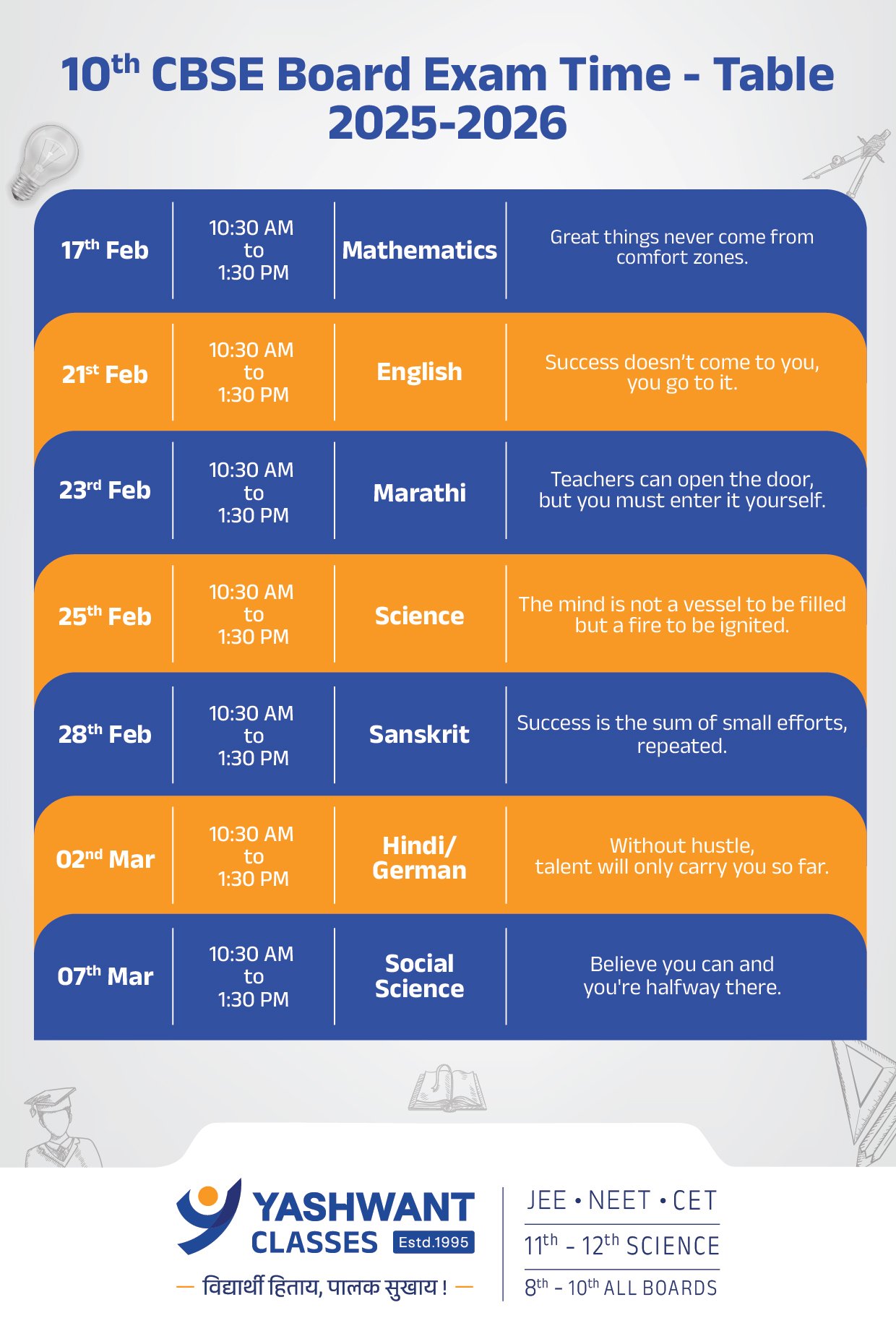
Paper Pattern
A strong performance in the Class 10 board exams begins with smart preparation. Students should be familiar with the entire syllabus, exam format, chapter-wise marks distribution, and the core concepts of each subject. Understanding these elements helps in managing time efficiently and focusing on high-scoring topics. This guide provides a comprehensive subject-wise exam pattern and weightage to help students prepare strategically and aim for top scores.
| Section | Question type | Questions | Marks per question |
|---|---|---|---|
| A | Multiple choice questions Assertion Reason questions | 1-18 19-20 | 1 mark each |
| B | Very Short Answer type questions | 21-25 | 2 marks each |
| C | Short Answer type questions | 26-31 | 3 marks each |
| D | Long Answer type questions | 32-35 | 5 marks each |
| E | Case study-based questions | 36-38 | 4 marks each with sub parts of the values of 1, 1 and 2 marks each. |
Weightage
In the CBSE Class 10 Mathematics syllabus, Algebra (Unit-II) has the highest weightage at 25% of the total score. Following this, Geometry (Unit-IV) holds approx. 19% weightage. Trigonometry (Unit-V) contributes 15%, and Statistics & Probability (Unit-VII) add approximately. 14%. Mensuration (Unit-VI) accounts for 12.5%, while Coordinate Geometry (Unit-III) and Number Systems (Unit-I) have the lowest weightage, each contributing 7.5%.
| Units | Units Name | Marks |
|---|---|---|
| I | Number Systems | 06 |
| II | Algebra | 20 |
| III | Coordinate Geometry | 06 |
| IV | Geometry | 15 |
| V | Trigonometry | 12 |
| VI | Mensuration | 10 |
| VII | Statistics and Probability | 11 |
Marks
The CBSE Class 10 Maths exam offers students the flexibility to choose between Standard Mathematics and Basic Mathematics, depending on their future academic goals. Mathematics Standard is intended for students aiming to pursue the subject in higher education and is slightly more challenging, while Mathematics Basic caters to students who want to focus on other streams and prefer an easier difficulty level.
Each paper carries a total of 100 marks, 80 for theory and 20 for internal assessment or project work. Below is the detailed CBSE Class 10 Mathematics paper pattern to help students plan their preparation effectively.
Ace Your Exams with CBSE Class 10 Sample Papers (with Solutions)
CBSE Class 10 Maths Sample Papers (with Solutions) help you practise smarter, understand tricky concepts, and boost your confidence to ace the board exams with ease. Click here:
Important Topics
Download Important Questions for Class 10 Maths Chapter-wise
- Important Questions Chapter 1 – Real Numbers
- Important Questions Chapter 2 – Polynomials
- Important Questions Chapter 3 – Linear Equations in Two Variables
- Important Questions Chapter 4 – Quadratic Equations
- Important Questions Chapter 5 – Arithmetic Progressions
- Important Questions Chapter 6 – Triangles
- Important Questions Chapter 7 – Coordinate Geometry
- Important Questions Chapter 8 – Introduction to Trigonometry
- Important Questions Chapter 9 – Some Applications of Trigonometry
- Important Questions Chapter 10 – Circles
- Important Questions Chapter 11 – Constructions
- Important Questions Chapter 12 – Areas Related to Circles
- Important Questions Chapter 13 – Surface Areas and Volume
- Important Questions Chapter 14 – Statistics
- Important Questions Chapter 15 – Probability
Conclusion
Smart preparation is the key to excelling in the CBSE Class 10 Board Exam 2026. A clear understanding of the syllabus, exam pattern, and chapter-wise weightage is essential for effective study planning. The information provided above will help you streamline your preparation, focus on important topics, and move one step closer to achieving excellent results.